See the idea working: a live AI product photography
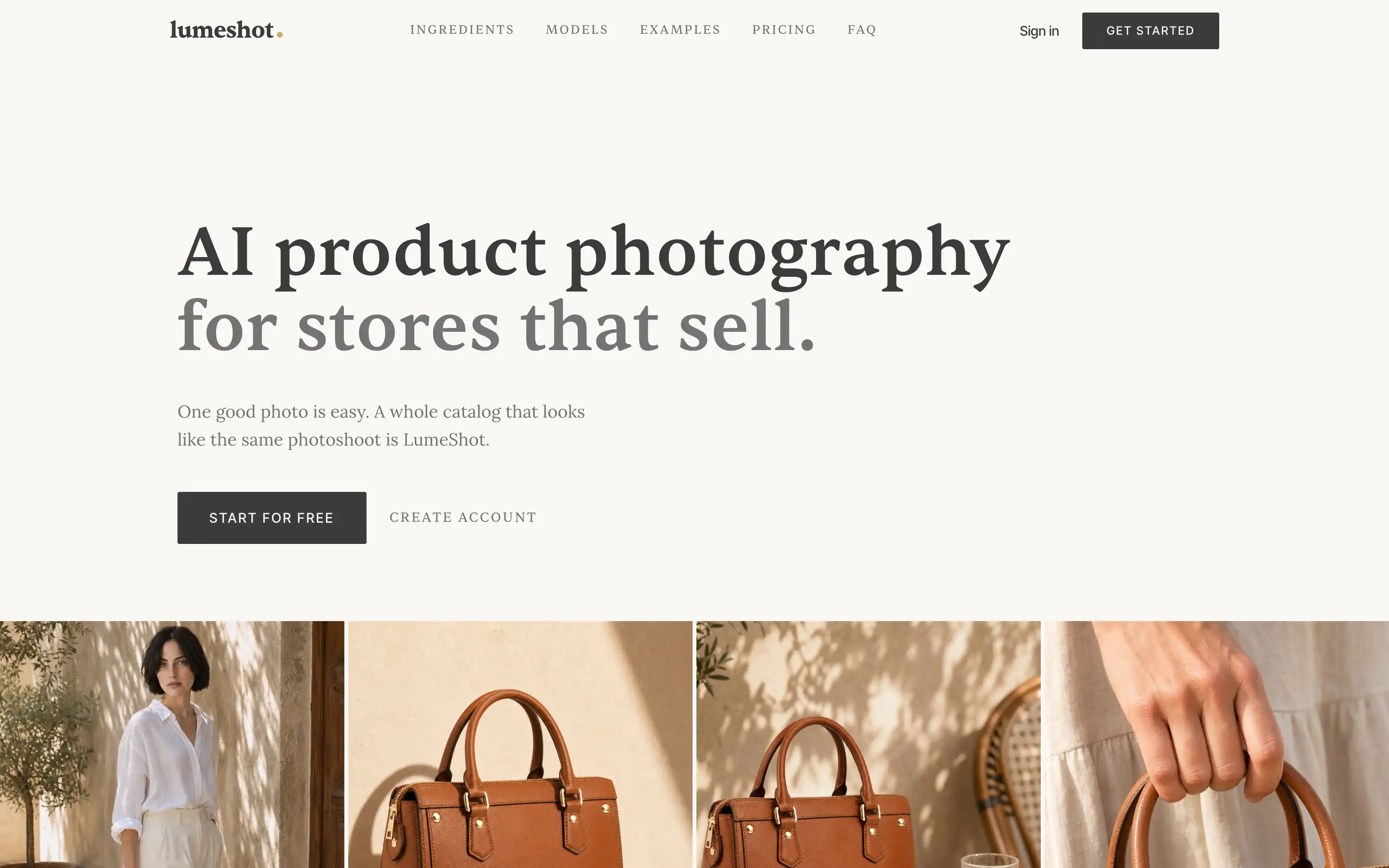
LumeShot shows the core job: upload the product, choose the scene and visual direction, and turn one source image into selling assets. A customer pays $25 a month for Studio after using six free shots; that payment unlocks unlimited shots, HD results, and every model, pose, style, and scene. doany AI is still running the image pipeline this founder first described in plain English: one product photo in, a campaign of selling assets out. It built the studio from that brief and opened it to customers. Your own product-photo company can begin with the same kind of direction.
You can build your own AI product photography company
Start with the same workflow, then bring in what you know. A jeweler can build a macro studio for Etsy shops; a restaurant marketer can build menu refresh packs; an agency operator can build a multi-client catalog system. Choose the customer, scene library, output rules, price, and look. Describe it in plain English and doany AI builds exactly what you described, then keeps the pages, customers, and product moving. The visual standard and market are yours to set. doany AI builds around them, keeps the image pipeline running, and delivers the work. You own the studio, its client relationships, and the revenue from each paid shoot.
People are already making money with AI product photography
These three products show the range of the same commercial job: help a seller create better product visuals quickly. Their paid offers cover higher-volume exports, branded workflows, and campaign production.
pixelcut.ai~12M visits/mo
Pixelcut combines product-photo backgrounds, editing, batch exports, and commercial-use plans. Public monthly pricing runs from free to $30.
 flair.ai~167K visits/mo
Flair focuses on AI product scenes, branded assets, and model imagery. Public plans run from free to $38 per month.
 pebblely.com~104K visits/mo
Pebblely turns product uploads into background and campaign images. Its public plans run from $9 to $39 per month.
The 2-day product built by a tiny team
In late 2022, Alfred Lua and Swee Kiat Lim had an image model but no product. Swee Kiat built a basic interface in two days and they launched Pebblely on January 4, 2023, with a test: reach $200 in revenue by the end of the month or move on. They passed it within two days of launch. By March the two founders were paying themselves salaries. Seven months after launch, Pebblely reported 1,060,000+ signups, paying customers in 100+ countries, and a team of 3.5 people: two founders, one engineer, and one part-time researcher. That growth shows how a tiny team turned the same product-photo job into a business serving paying customers worldwide.Sources: Pebblely one-million-signups report · Alfred Lua 2023 annual review
How an AI product photography business makes money
Let a seller test the product on one or two images, then charge for the volume, consistency, export quality, collaboration, or specialist scenes needed to finish a catalog.
1Who pays for an AI product photography
Etsy makers, Shopify brands, Amazon sellers, restaurant owners, and e-commerce agencies all need new imagery whenever a product, campaign, marketplace, or season changes. They pay to avoid coordinating a fresh photographer, studio, props, and model for every batch.
2What customers pay for AI product photography
| Site | The hook | The paid plan |
|---|---|---|
| pixelcut.ai | free editing and limited exports | $10–$30/mo for Pro and Business |
| flair.ai | free plan | $8–$38/mo across paid plans |
| pebblely.com | $9 entry plan | $9–$39/mo by image volume |
The common model is free or low-cost proof, then recurring payment for volume and workflow. Price against generation, storage, retries, support, and acquisition — not only the model call.
3Where AI product photography customers come from
Search for a specific photo problem
Sellers search by outcome: jewelry backgrounds, Amazon listing photos, on-model fashion, menu photography, or product mockups.
Marketplaces and seller communities
Shopify, Etsy, Amazon, restaurant, and maker communities already gather the people trying to improve a catalog without a new shoot.
A free tool that proves product accuracy
A background remover, listing-size converter, or sample scene lets the customer test whether the tool preserves the actual product.
Agencies and specialists as partners
E-commerce agencies, photographers, marketplace consultants, and brand designers can bring multiple clients to a specialist studio.
4What decides which AI product photography wins
Consistency and niche knowledge win. A jewelry studio must preserve stones and metal; a food studio must make dishes believable; a fashion studio must keep garments accurate across models. Generic beauty is less valuable than dependable output for one seller.
Operations matter too: useful retries, clear usage rights, honest examples, fast support, and fresh campaign templates. You bring the taste and market knowledge; doany AI handles the daily repetition.
How to build your AI product photography company
Choose one seller and one recurring photo problem before choosing dozens of features. Define what must remain exact, which scenes matter, how output is packaged, and what the customer pays. Then describe it in plain English and doany AI turns the plan into a live studio.
You describe the company you want. doany AI puts it live.
Choose the seller, source-photo requirements, output formats, scene library, product-accuracy rules, free sample, and paid plan. doany AI builds the upload flow, results, checkout, and branded pages around it.
You change your mind anytime. doany AI rebuilds on the spot.
Say “add jewelry close-ups,” “create a holiday launch pack,” or “make label preservation stricter.” doany AI updates the scenes, generation rules, offers, and pages without discarding the working core.
You choose who to sell to. doany AI goes out and finds them.
doany AI publishes pages for the exact catalog problems your market searches, creates useful free tools, and helps reach agencies and seller communities that already serve the audience.
doany AI handles the 2am questions. You wake up to the highlights.
It handles common questions about product accuracy, retries, image rights, billing, and delivery, then surfaces unusual cases for your judgment.
You're the founder. doany AI is the team. You own the studio's taste, customer relationships, and revenue; doany AI keeps production and growth moving every day.
Questions before you build one
Is an AI product photography business profitable?
It can be. Pebblely's founders documented revenue within two days and paying themselves by month three, but that does not predict a new site. Profit depends on image cost, retries, support, conversion, retention, and how efficiently you reach sellers.
How much does it cost to start an AI product photography business?
A custom product needs generation models, storage, payments, hosting, and ongoing product support. On doany, you describe the specialist studio you want and the platform builds and operates it starting at $25 per month.
I can't code. Can I still run this company?
Yes. Your work is choosing the seller, quality bar, scene direction, pricing, and claims. You direct changes in plain English while doany AI builds and operates the product.
Isn't AI product photography too crowded?
Generic image editing is crowded, but seller-specific workflows remain different. A menu studio, jewelry macro service, and furniture staging tool do not solve the same job. At $29 per month, one customer covers the $25 starting monthly platform price, giving you a small first validation target.
Do I own the AI product photography company?
Yes. You own the brand, domain, customer relationship, business direction, and revenue. You can change the niche, visuals, pricing, or workflow by giving a new instruction.