Category map and comparison
Best AI company builders. Choose the kind of company you need to build.
“AI company builder” covers six kinds of tool, so decide which kind you need first. Then compare the cut of your sales: Crevio 1–5%, Polsia 3%, NanoCorp 20% of withdrawals, and DoAny 0%, with Stripe’s fees on top in every case.
- 6Kinds of tool commonly called an “AI company builder”
- 1–20%What Crevio, Polsia, and NanoCorp take from sales or withdrawals
- $200Monthly sales below which Crevio Pro costs less than DoAny Pro
Define the category
What is an AI company builder? Six kinds of tool
Start with what the business needs made (a site, an app, a store) and what has to keep running. A founder launching software faces different gaps from a local service provider or an online merchant. Every DoAny comparison is on the comparison index.
Swipe to compare every column.
| Category | What it primarily creates | What it may keep operating | Typical gap |
|---|---|---|---|
| Company operator | Connected plan, product, site, positioning, and workflows | Growth, outreach, support, finance, and scheduled work | Autonomy, fees, and account control differ substantially |
| Go-to-market agent team | Marketing site, positioning, outreach, social posts, and briefs for your engineers | Sales, marketing, support, and operations work | Expects the core product to be built and hosted somewhere else |
| Service-business suite | Website, offers, bookings, customer records, and payments | Reviews, communication, and local-business administration | May not provide portable source code or software-product tooling |
| App and product builder | Web software, database, authentication, integrations, and hosting | Deployment, iteration, and some product analytics or marketing | Usually does not operate the whole company |
| Commerce platform | Storefront, catalog, checkout, orders, and merchant workflows | Commerce operations and store administration | Specialized for selling products, not every business model |
| Planning cofounder | Research, positioning, validation, and a launch plan | Guidance and project structure | Execution may still require separate build and operating tools |
Ask what leaves the platform
“You own your app” is only one question. Test whether source code, databases, users, customers, content, domain, analytics, payment accounts, advertising accounts, and infrastructure can each move with you.
Best fit, not first place
The 14 best AI company builders, grouped by fit
The shortlist is grouped by documented role. For the other platforms, a broad vendor claim is not treated as proof that the platform performs every function reliably. Rows move from broader company operators to more specialized builders; they are not a numerical ranking. Each platform with its own guides links to a full side-by-side comparison with DoAny and to its alternatives.
Swipe to compare every column.
| Platform | Category and best fit | Current documented scope | Important limit |
|---|---|---|---|
| DoAnyIncluded publisher | Company operator for a founder seeking one connected environment | Researches the idea, builds and hosts a web app with accounts, data and Stripe checkout, then posts daily, does outreach and answers customers. | Builds web apps only, with no native mobile apps, and buys no ads for you. |
| PolsiaDoAny vs Polsia · Polsia alternatives | Company operator for founders comfortable with scheduled execution | The vendor says it plans, codes, markets, runs advertising, posts, replies, and supports sales work. | Terms describe managed resources, scheduled actions, payment settlement, and advertising fees that need close review. |
| RunableDoAny vs Runable · Runable alternatives | General-purpose agent for small-business owners who want paid ads, phone channels, or native mobile apps | One agent for websites, web apps and native iOS and Android apps; Grow (August 26, 2026) adds paid ads, social posting and cold calls. | The Free plan can’t build websites or apps; building, Stripe, and publishing start at Pro. Top-up prices and per-task credit costs aren’t published. |
| CrevioDoAny vs Crevio · Crevio alternatives | Company operator for creators, coaches, and solo sellers of digital products and services | Vendor-stated: builds the site and first product, sets up checkout, answers email and phone, posts to social, buys the domain and forms a US LLC. | Takes 5%, 2.5%, or 1% of each sale, on top of Stripe’s fees. Changes go straight to the live site: “There’s no staging site.” |
| CofounderDoAny vs Cofounder · Cofounder alternatives | Go-to-market agent team for founders who already have a product, especially new B2B software companies | Agent departments for engineering, sales, marketing, design, support, operations, finance and legal; it builds the marketing site and briefs your engineers. | Its docs say “Cofounder is not your core product builder.” Your app, database, sign-in, and product hosting stay in your own stack. |
| DurableDoAny vs Durable · Durable alternatives | Integrated suite for local and professional services | Website, imagery, search and AI-answer visibility (SEO/GEO), reviews, bookings, CRM, AI assistance, and payments. | Contact export is documented; full site and code portability was not established from the reviewed public pages. |
| AtomsDoAny vs Atoms · Atoms alternatives | App builder with research, SEO, and Google Ads agents, for founders who want the idea checked, built, and marketed | Agents research your idea, build a web app (sign-in, database, Stripe), write SEO pages and run Google Ads; Android builds since May 6, 2026. | A live app draws on a dollar Cloud & AI Balance with no public rate card; features “can stop when their available Balance runs out.” |
| Base44 | Full-stack app, site, product, and agent builder | Backend, storage, authentication, payments, hosting, SEO/GEO, social, and analytics are described. | Its documentation notes that app users cannot currently be exported when cloning an app. |
| LovableDoAny vs Lovable · Lovable alternatives | Full-stack web-product builder with source-control paths | Frontend, backend, database, authentication, integrations, editable code, deployment, GitHub sync, and payments. | Public evidence is strongest for product infrastructure, not autonomous operation of every company function. |
| BlinkDoAny vs Blink · Blink alternatives | App builder that hosts what it builds, for non-technical founders making an MVP, client portal, or booking app | Web apps, websites, Chrome extensions and native iOS and Android apps, with its own database, sign-in, storage and hosting; always-on agents billed per agent. | Taking real payments needs Pro ($50 a month), and production hosting is billed in credits per project on top of the plan. |
| Replit Agent | Conversational software building and deployment workspace | App and site creation, database, authentication, integrations, agents, automation, and deployment. | Replit's own guidance keeps strategy, review, testing, and checkpoints with the user. |
| Shopify with Sidekick | Commerce-specific company platform | Store-context help with products, orders, analysis, content, administrative changes, and limited generated apps. | Not a general service-company or software-company operator. |
| BuildpadDoAny vs Buildpad · Buildpad alternatives | Planning cofounder for structured idea-to-company work | Buildpad describes guided research, validation, positioning, and launch planning. | Claims come from its own product and educational pages; downstream execution needs to be assessed separately. |
| NanoCorpDoAny vs NanoCorp · NanoCorp alternatives | A newer platform that runs a business on its own | Its pricing and comparison pages describe credits, business workflows, and a Polsia alternative position. | Evidence reviewed here comes only from NanoCorp’s own pages and is thinner than for the core categories above. |
Swipe to compare every column.
| Platform | Public entry point | Usage model | Extra commercial terms to review | Primary source |
|---|---|---|---|---|
| DoAny | Free at $0; Pro starts at $25 per month. Free can go live and take real card payments; Pro adds your own domain. Every plan has unlimited companies. | Free: 5 credits a day, up to 30 a month. Pro: 100 monthly credits plus 5 a day. One balance is shared by every company. Top-ups (Pro) $15 per 50 credits, valid 12 months | 0% of your sales on every plan, Free included (Stripe’s fees apply); credits stop hard, with no overage | DoAny pricing |
| Polsia | Homepage says free to start without a card | Free with 3 starter credits; Standard $20 a month for 20 credits, Pro $50, Max from $100 (help center) | 3% of customer payments and 20% of a configured advertising budget, per its current Terms | Polsia Terms |
| Runable | Free at $0, but it can’t build sites or apps; Pro $20 a month ($180 for the first year as shown, renewal price unpublished); Max $100 a month | Pro: 25,000 credits a month plus 1,500 a day, with daily credits capped at 15,000 a month (40,000 a month at most) | No fee on your sales is listed; fees are “non-refundable unless required by law” (Runable Terms) | Runable pricing; Runable FAQ |
| Crevio | Starter $0 with no card (up to 2 active products, no custom domain); Pro $20 a month or $192 a year; Business $50 a month or $480 a year | One credit wallet at $0.02 a credit; top-ups from $5 for 250 credits on paid plans | 5% of each sale on Starter, 2.5% on Pro, 1% on Business, on top of Stripe’s fees | Crevio pricing; credits docs |
| Cofounder | 7-day free trial, then no free plan; Cofounder Pro “Starting at $120 / month”, billed monthly | Included usage and overage rates aren’t published; “Usage-based charges are billed in arrears” | “Each organization requires its own subscription.” No fee on your sales is listed | Cofounder pricing; Cofounder Terms |
| Atoms | Free at $0 with 15 credits a day (up to 25 a month); Pro $20 a month for 100 credits, or $15.80 a month billed yearly ($189.60 up front); Max from $100 a month | Build credits for agent work, plus a separate dollar Cloud & AI Balance for hosting, database, storage, and in-app AI; build-credit top-ups aren’t sold | 0% of your sales: you “keep full revenue minus standard Stripe processing” | Atoms pricing |
| Blink | Free at $0 (5 credits a day, up to 30 a month; a public preview only); Starter $25 a month or $150 a year; Pro $50 a month or $300 a year | Plan credits plus 5 a day; production hosting is billed in credits per project, from 50 credits a month | “Blink adds no fee on your sales.” Taking real payments needs Pro; fees are non-refundable (Blink Terms) | Blink pricing; payments page |
| Buildpad | Free trial; paid Pro and Max plans | Monthly credits with unused credits rolling over | Confirm the active monthly or annual billing view before purchase | Buildpad pricing |
| NanoCorp | Three-day trial; Founder at $30 per month | Founder includes 30 credits per month | Pricing page lists a 20% fee on withdrawals | NanoCorp pricing |
What a share of your sales costs
Take a founder selling $2,000 a month who wants their own domain. Crevio costs $70 a month on Pro ($20 plus $50 at 2.5%) and the same on Business ($50 plus $20 at 1%). Crevio’s own blog says “There’s no plan with a 0% fee.” DoAny Pro costs $25 a month and takes 0% (Stripe’s fees apply). Below $200 a month in sales, Crevio Pro costs less than DoAny Pro.
Without your own domain, Crevio Starter’s 5% is $100 a month on the same sales, while DoAny Free is $0 and takes 0%. Stripe’s processing fees apply to both.
Swipe to compare every column.
| Category | Build product or site | Growth and sales | Ongoing operations | Evidence status |
|---|---|---|---|---|
| DoAny | Builds and hosts the web app | Annie posts daily, does outreach and runs the CRM | Answers customers around the clock; big calls wait for approval | Described first-hand by the publisher |
| Polsia, Runable, and Crevio | Documented | Documented by vendor | Documented by vendor | Broad company scope; performance not tested |
| Cofounder | Marketing site only; its docs exclude the core product | Documented by vendor | Documented by vendor | Go-to-market scope for a product built elsewhere |
| Durable | Documented for service-business website | Partial through SEO, reviews, CRM, and payments | Documented within its suite | Strongest for service businesses |
| Base44, Lovable, Replit, Atoms, and Blink | Core documented capability | Partial and platform dependent | Technical operation documented | Company-wide operation not established |
| Shopify with Sidekick | Core for commerce | Core within commerce | Core within store administration | Specialized category, not general purpose |
| Buildpad and NanoCorp | Varies | Vendor-stated | Vendor-stated or partial | Needs deeper account-level verification |
Documentary evidence
What each AI company builder’s own pages say
Each image is a dated capture of a primary source. It shows what the vendor published, not whether the product delivered that outcome in a real company.

Polsia presents a broad company-operation promise. The terms are needed to understand the account, fee, and approval model behind it.
Polsia: Polsia homepageofficial product, checked September 2, 2026
Polsia's terms document managed infrastructure, ownership language, and scheduled operations. Review the live terms before relying on them.
Polsia: Terms of Service, infrastructure and scheduled operationsofficial terms, checked September 2, 2026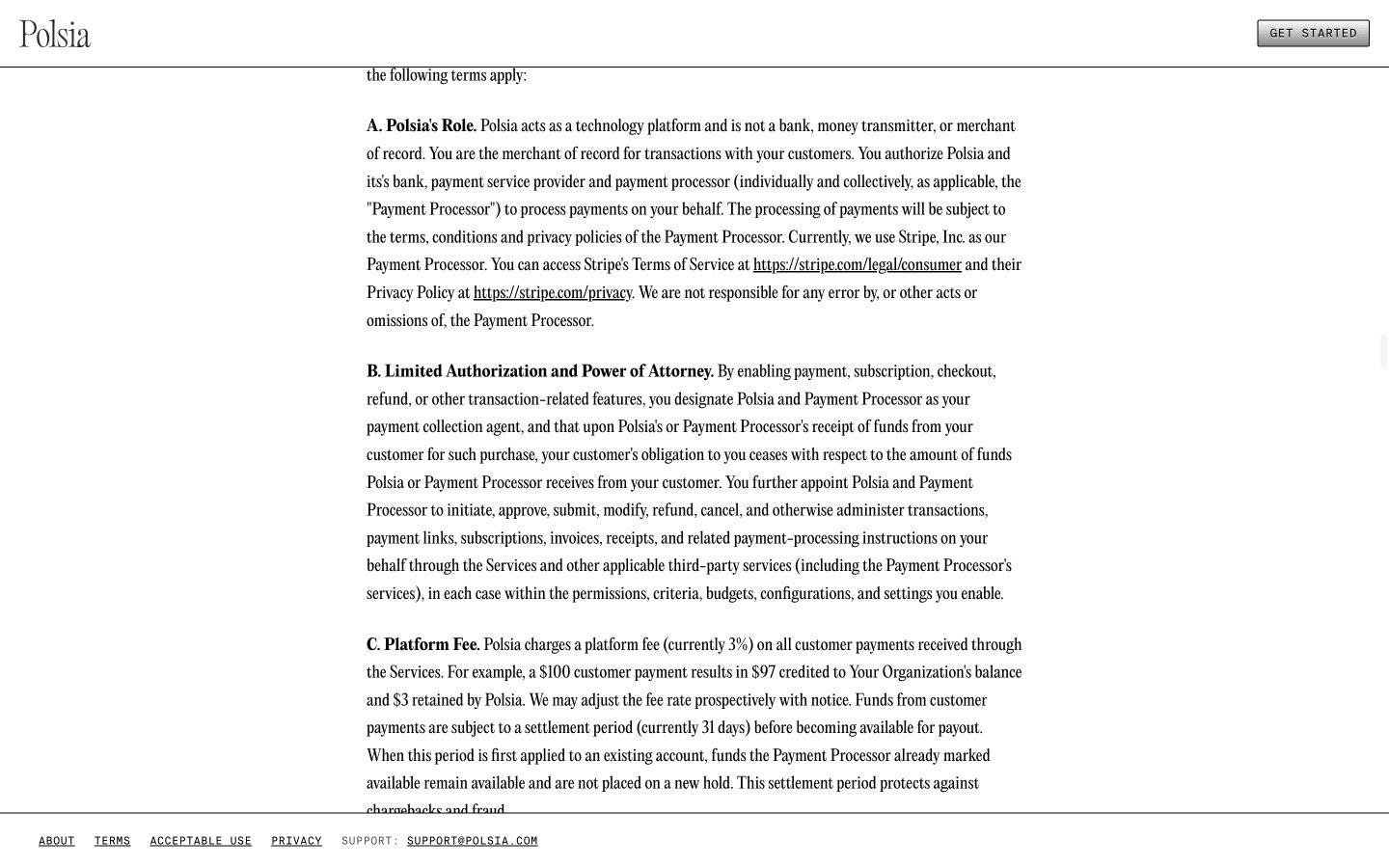
The captured terms separate payment-related and advertising-related commercial conditions. They are dated and intentionally not reduced to one headline percentage.
Polsia: Terms of Service, section 4: Revenue and Feesofficial terms, checked September 2, 2026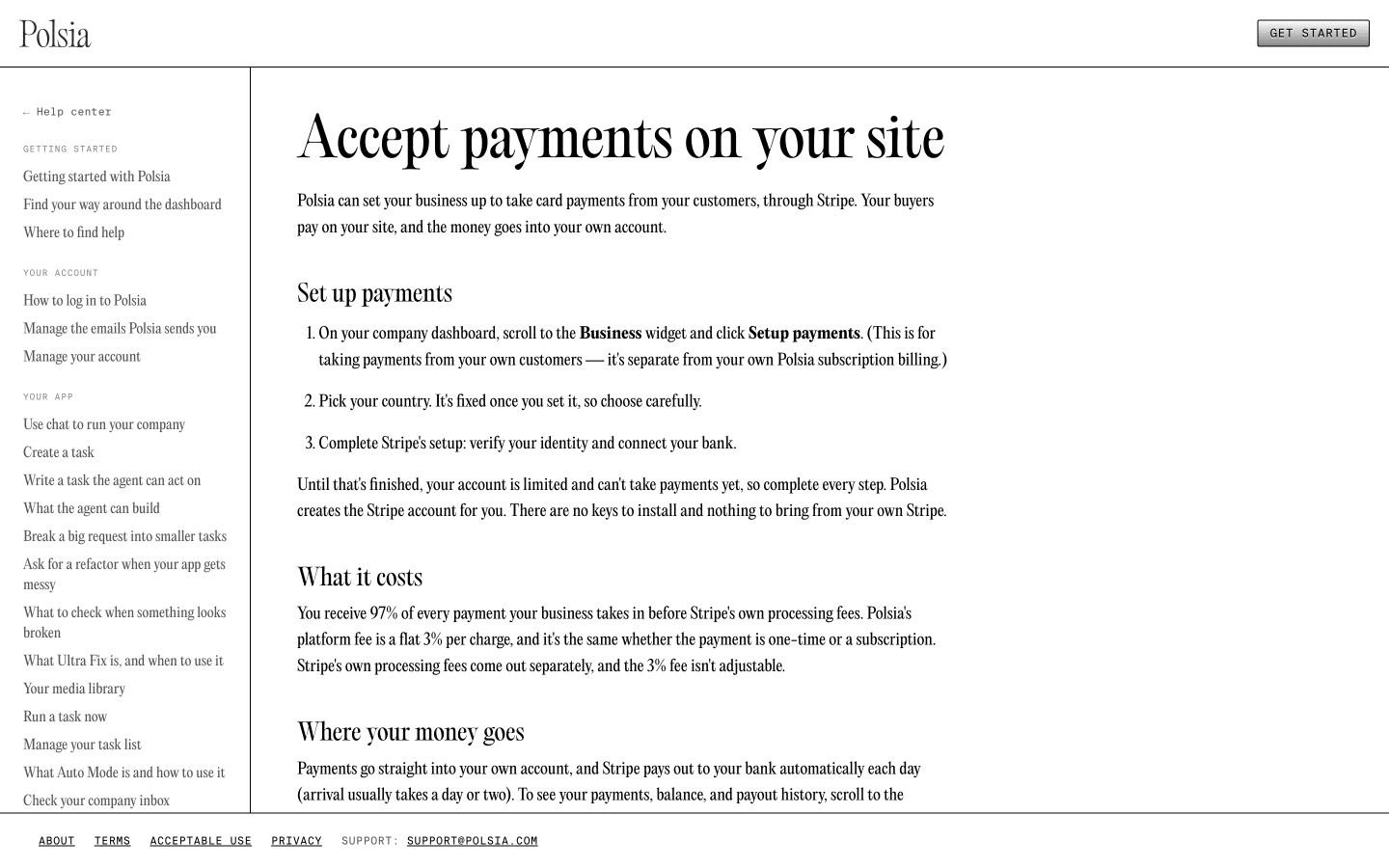
Polsia's help article documents its payment setup and payout flow. This does not test settlement reliability.
Polsia Help: Accept payments on your siteofficial help, checked September 2, 2026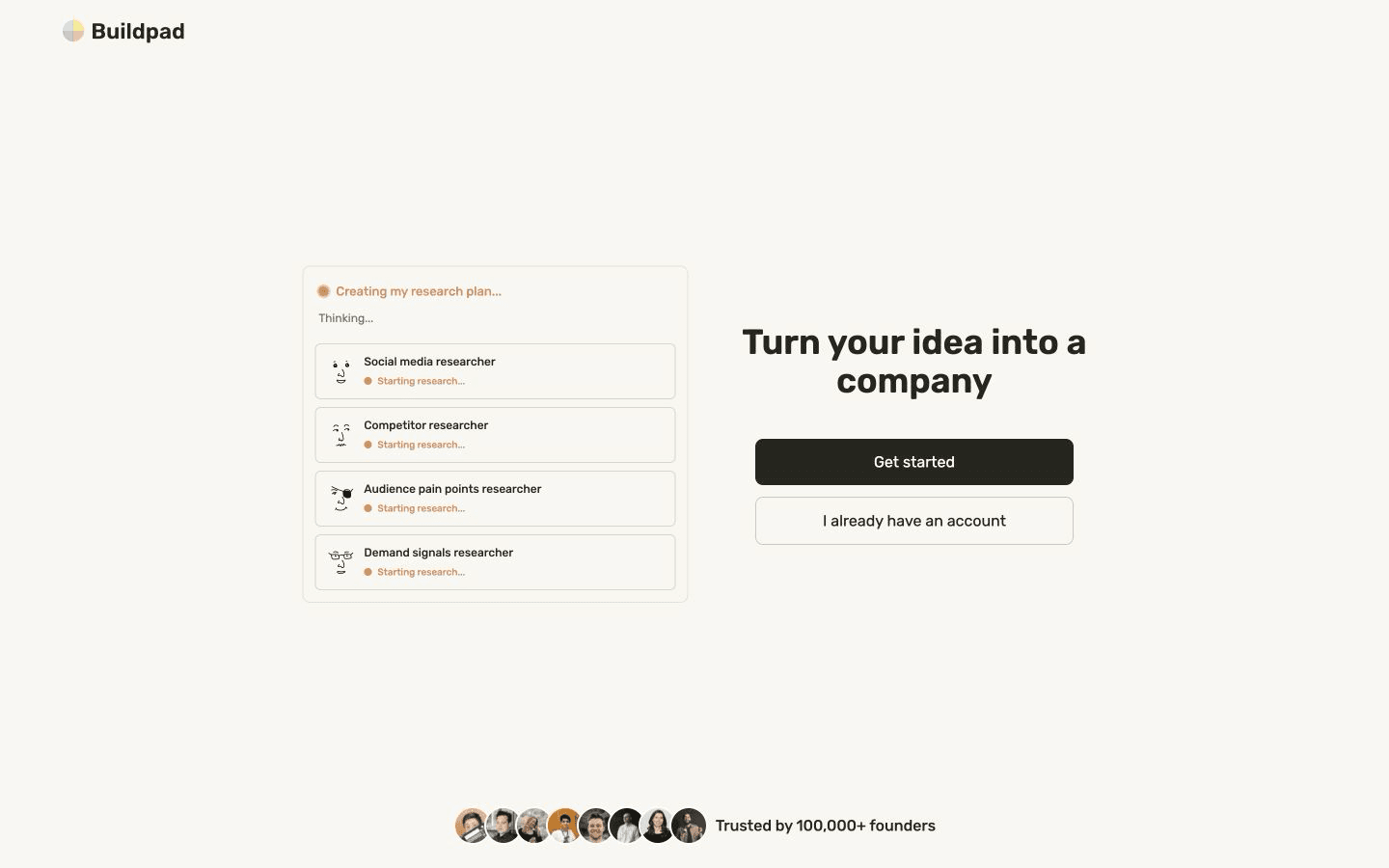
Buildpad describes a guided idea-to-company workflow. The capture supports positioning, not validation quality.
Buildpad: Buildpad homepageofficial product, checked September 2, 2026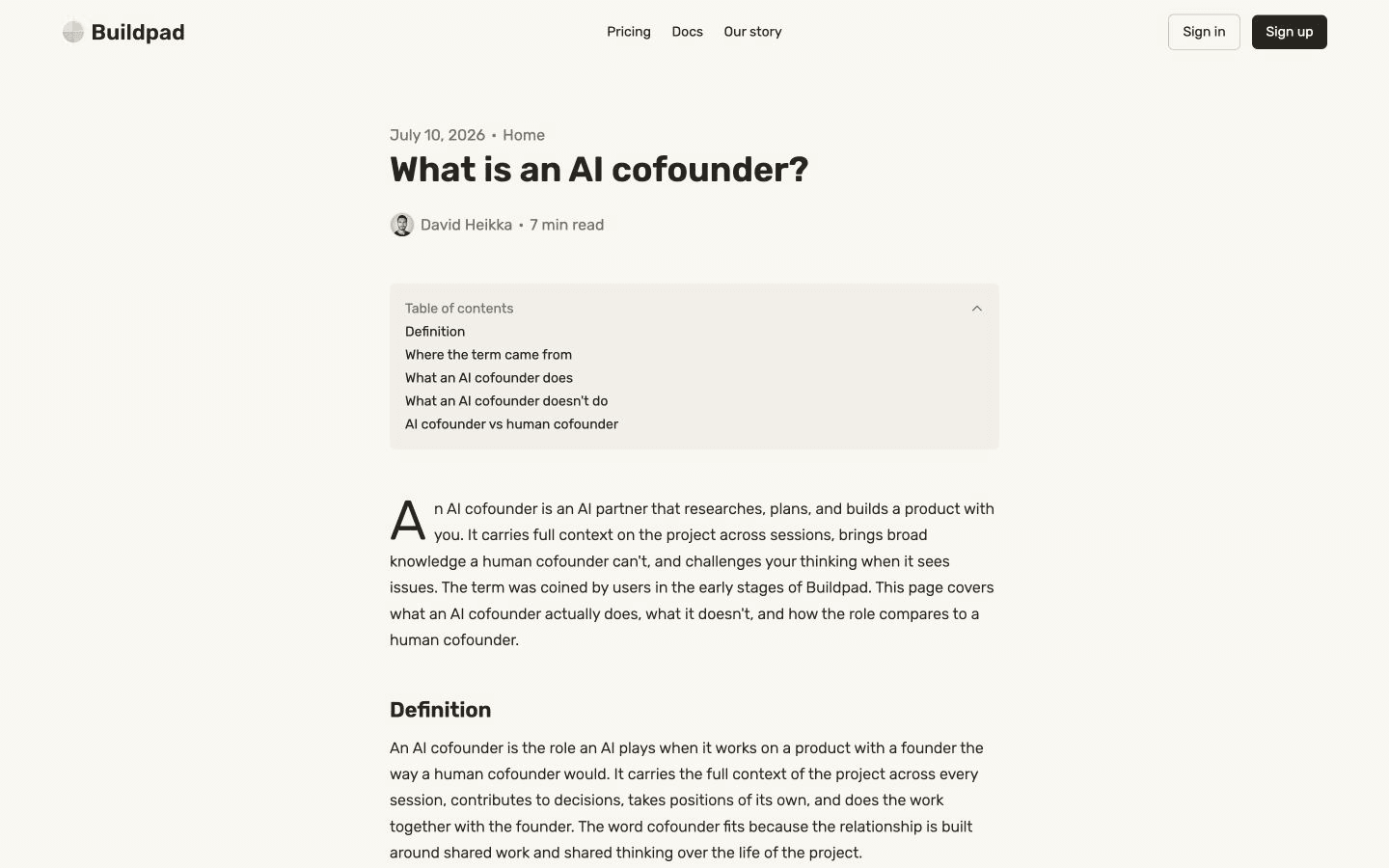
Buildpad's own article defines the AI cofounder role as support alongside a human founder. It is a vendor-authored category explanation.
Buildpad: What is an AI cofounder?article, checked September 2, 2026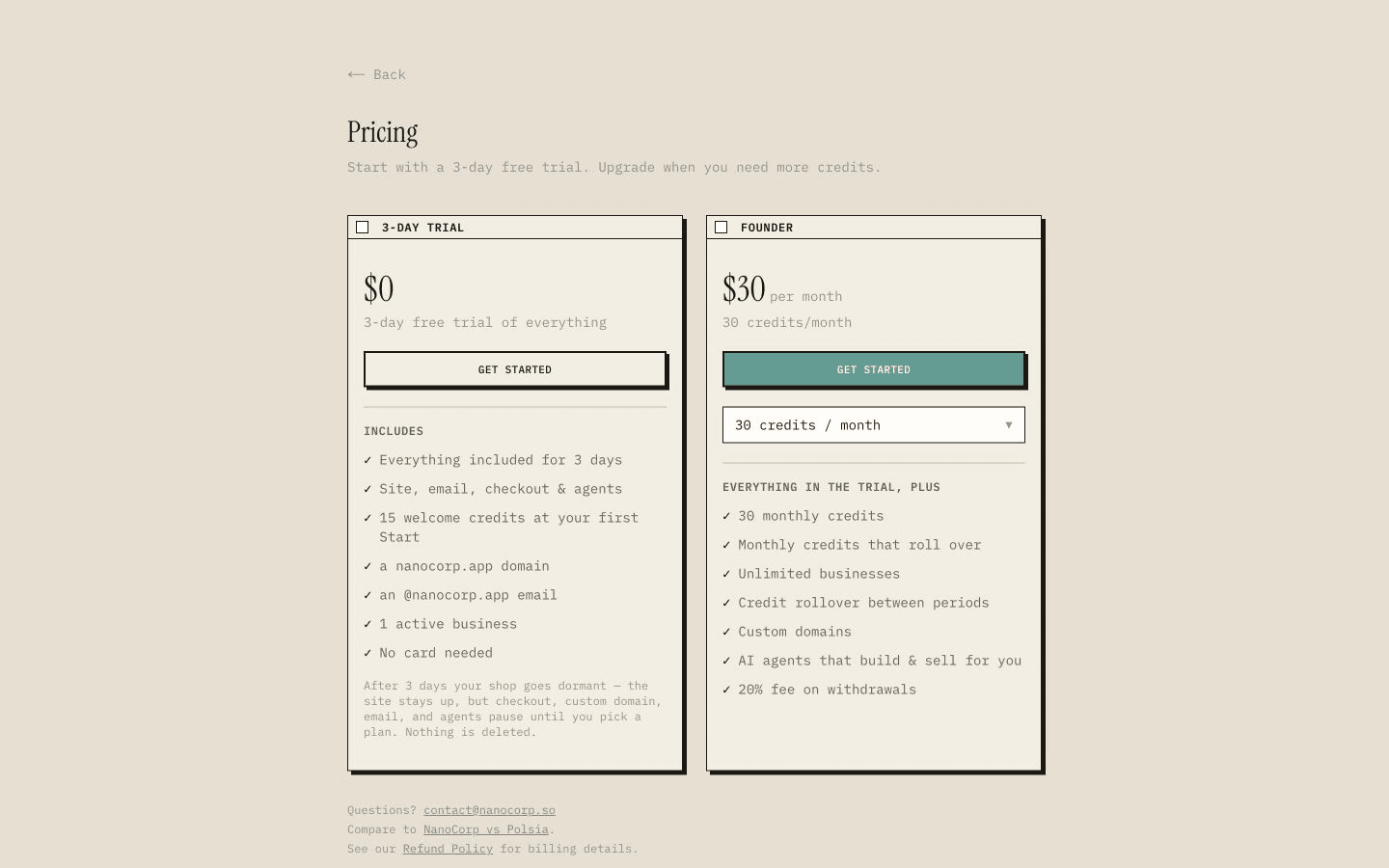
NanoCorp's dated pricing page documents its plan and credit model. Current figures should be checked on the live page.
NanoCorp: NanoCorp pricingofficial product, checked September 2, 2026Ownership and exit
Who owns the code, data and customers on each builder
Ownership language can be broad while a practical migration path is narrow. The safest trial includes an export and exit test, not only a successful first build. Switching in, DoAny imports your existing code and database records, so you don’t start over.
Swipe to compare every column.
| Platform | Documented owner or export path | Known or unresolved dependency | Primary source |
|---|---|---|---|
| DoAny | You own what DoAny builds for you, as between you and DoAny (Terms). Export your code and data anytime and sync your code to GitHub. | Third-party and open-source licenses. On a switch, payments and logins move separately: a new Stripe account opens at Go live. | DoAny Terms of Service; DoAny FAQ |
| Polsia | Terms say customers retain inputs and outputs. | Cloud resources can be held in managed accounts unless the customer supplies credentials; advertising can use a service-managed account. | Polsia terms |
| Runable | Terms: you keep your “User Content”, and “You may use exported outputs commercially.” Paid plans can export code as a ZIP or to GitHub. | The pricing page lists “No Data Export” for Free. Nothing public says whether history in a Runable-managed ad account moves with you. | Runable Terms of Service |
| Crevio | Terms: you own content and outputs “generated specifically for your use”. You can connect your own GitHub repo so Crevio builds and deploys from it. | No export of an existing site’s code or database is documented, and “Orders cannot be exported to CSV”. | Crevio Terms of Service; apps docs |
| Cofounder | Terms: “You retain all right, title, and interest in and to Customer Data.” Pro users can claim the GitHub, Supabase and Vercel projects. | Claiming is discouraged: the pricing page adds “We do not recommend it”. After termination, data can be exported for 30 days, then deleted. | Cofounder Terms |
| Durable | Customer contacts can be exported as CSV. | Full website and source-code export not established | Roles and permissions |
| Atoms | Terms: “Atoms makes no claim to ownership” of what you generate. ZIP export and GitHub sync need a paid plan: “Export requires Pro”. | Free has no export or GitHub sync, although the homepage FAQ says you can export “anytime”. | Atoms Terms of Service |
| Base44 | Documentation describes creator ownership and app-data export. | App users cannot currently be exported while cloning an app. | Base44 privacy and security |
| Lovable | Two-way GitHub synchronization and external deployment are documented. | Managed services and paid-feature requirements still need review. | Lovable GitHub integration |
| Blink | Terms: you “retain full ownership” of what you create. Two-way GitHub sync works on every plan, Free included. | The code export leaves out secrets, database data, and the Blink runtime, so leaving means replacing Blink’s sign-in, data, storage, and AI services. | Blink Terms of Service |
| Replit | Import, source control, development, and deployment paths are documented. | Test the full application, data, secret, and hosting exit path. | Replit import documentation |
Swipe to compare every column.
| Platform | Documented review model | Consequential action to test |
|---|---|---|
| DoAny | Approval cards gate turning on payments (“Set up payments” / “Not now”), paid video renders, new recurring jobs, connecting outside accounts, saving automations, and adding code packages; typing “yes” in chat doesn’t count. | Everyday work doesn’t wait for an approval card on each item; spending can’t go past the credits you bought, and DoAny buys no ads and never charges your card on its own. |
| Polsia | Terms describe some scheduled advertising, outreach, and infrastructure actions after general approval, with controls to disable them. | Test schedule, pause, cancellation, and account-level visibility. |
| Runable | Runable 2.0 “shows you a visual plan, and only builds after you approve”. | Check which Grow agents post, reply, or call without a draft step, and how an ad budget is approved and charged. |
| Crevio | Each standing job is set to “Do it automatically”, “Ask me first”, or “Just suggest” (automation docs). The Terms say scheduled workflows run “without per-execution approval”. | The docs don’t say which setting a new job starts on, and “Do it automatically” means Crevio “completes the job and tells you afterward”. |
| Cofounder | The homepage says “nothing ships without your approval”, and the docs describe an Approve card before staging deploys. | The Terms say merges and deploys on connected repos “may occur without prior human review”, and let you disable automated agent actions. |
| Atoms | The team-leader agent posts plan cards you Approve or Decline; the ads agent needs owner approvals and creates campaigns paused. | In the ads agent, “Low- and medium-risk recommendations can apply immediately.” |
| Blink | Production changes only when you click Publish, and every AI turn saves a version you can restore. | Its always-on agents “do the work instead of suggesting it”; no approval step is documented before they send outreach email, post, or place a call. |
| Shopify Sidekick | Shopify documents review before proposed changes are applied. | Check which generated applications and actions remain admin-only. |
| Replit Agent | Official guidance assigns strategy, review, tests, and checkpoints to the user. | Review deployment, secrets, authentication, and destructive data changes. |
| Other shortlisted platforms | Not fully established from the reviewed public sources. | Test publishing, sending, payments, refunds, data changes, and deletion separately. |
Match the business model
Which AI company builder fits your business model
A narrow tool that holds your main records (customers, orders) can be safer and more useful than a broad platform that does not fit the business.
Swipe to compare every column.
| Business model | Evaluate first | Plausible platforms | Specialist gap to expect |
|---|---|---|---|
| Local or professional service | Bookings, CRM, reviews, invoicing, and website control | Durable, Crevio, or a broad company operator | Industry licenses, field operations, or specialist accounting |
| Consultancy or agency | Offer validation, pipeline, delivery, approvals, and margin tracking | DoAny, Polsia, Runable, Crevio, Durable, or a modular stack | Client-specific delivery and contractual review |
| Software as a service | Code ownership, database, authentication, billing, deployment, and support | Base44, Lovable, Replit, Atoms, Blink, or a company operator; Cofounder once the product exists | Security review, observability, compliance, and product support |
| Native mobile app | Developer accounts, in-app purchase rules, store review, and who submits the build | Runable, Blink (store publishing on Max), or Atoms (Android builds) | Store review, developer-account fees, and store fees on digital goods |
| Ecommerce | Catalog, checkout, orders, returns, payments, and customer data | Shopify with Sidekick | Supply chain, tax, fulfillment, and regulated product rules |
| Course or community | Audience validation, content ownership, payment, access, and moderation | Crevio, or a company operator plus a specialist delivery platform | Learning delivery, community safety, and creator-rights controls |
Method and limits
How we compared these AI company builders
We included platforms with a current public product surface and a distinguishable company-building role. Stronger conclusions require primary terms or help documentation, not only a homepage.
Facts about the other platforms were checked against linked sources on September 2, 2026, with a page review on September 3, 2026. Runable, Crevio, Cofounder, Atoms, and Blink were added on September 27, 2026, from their public pricing pages, help docs, and terms, checked that day. Commercial terms need a fresh check before purchase.
Swipe to compare every column.
| Evidence type | Allowed conclusion | Required caution |
|---|---|---|
| Official terms and help | Documented ownership, billing, controls, or limitations | Terms can change; verify the live version before commitment |
| Official product page | Vendor's current positioning and described capability | Label as vendor-stated unless supported by detailed documentation |
| Vendor comparison article | How that vendor frames the category | Do not treat it as independent product evaluation |
| Not performed | None | No account tests, benchmarks, migrations, support tests, security audits, customer verification, or ratings |
Source record
Sources and method
Every source below is linked where it is used above. Each entry carries the date we checked it.
- DoAny: DoAny homepageofficial product, checked September 3, 2026
Our own homepage, describing DoAny first-hand.
- DoAny: DoAny pricingofficial product, checked September 3, 2026
Our own pricing page, with DoAny’s current plans and prices.
- DoAny: Terms of Serviceofficial terms, checked September 3, 2026
- Polsia: Polsia homepageofficial product, checked September 2, 2026
Vendor-stated positioning. Terms and help pages provide the narrower control and billing evidence.
- Polsia: Terms of Service, section 4: Revenue and Feesofficial terms, checked September 2, 2026
Commercial clauses are date sensitive. Do not combine differently based fees into one percentage.
- Polsia: Terms of Service, infrastructure and scheduled operationsofficial terms, checked September 2, 2026
- Polsia Help: Accept payments on your siteofficial help, checked September 2, 2026
- Polsia Help: Standard, Pro, and Max plansofficial help, checked September 25, 2026
- Polsia Help: Credits for adding another companyofficial help, checked September 25, 2026
- Runable: Homepageofficial product, checked September 27, 2026
- Runable: Pricingofficial product, checked September 27, 2026
- Runable: FAQofficial help, checked September 27, 2026
Runable’s help center at docs.runable.com no longer resolves; the FAQ, product pages, and legal pages are its current public documentation.
- Runable: App builderofficial product, checked September 27, 2026
- Runable: Runable Grow launch post (August 26, 2026)article, checked September 27, 2026
- Runable: Runable 2.0 (March 7, 2026)article, checked September 27, 2026
- Runable: Terms of Service (last updated January 8, 2026)official terms, checked September 27, 2026
- Runable: Runable vs Lovableofficial product, checked September 27, 2026
Vendor comparison page. Used only for Runable’s own description of its export options.
- Crevio: Homepageofficial product, checked September 27, 2026
- Crevio: Aboutofficial product, checked September 27, 2026
- Crevio: Pricingofficial product, checked September 27, 2026
The pricing FAQ contradicts the 1% Business fee; the plan cards, the pricing table, Crevio’s About page, and its blog all say every plan carries a fee.
- Crevio: Ecommerce payment processing (September 13, 2026)article, checked September 27, 2026
- Crevio: Creditsofficial help, checked September 27, 2026
- Crevio: Appsofficial help, checked September 27, 2026
- Crevio: Automationofficial help, checked September 27, 2026
- Crevio: Physical goodsofficial help, checked September 27, 2026
- Crevio: Terms of Serviceofficial terms, checked September 27, 2026
- Cofounder: Homepageofficial product, checked September 27, 2026
- Cofounder: What Cofounder doesofficial help, checked September 27, 2026
- Cofounder: Pricingofficial product, checked September 27, 2026
- Cofounder: After onboardingofficial help, checked September 27, 2026
- Cofounder: Request a deployofficial help, checked September 27, 2026
- Cofounder: Terms of Service (last updated May 7, 2026)official terms, checked September 27, 2026
Cofounder’s Terms bar using the service “for comparative analysis, benchmarking”, so this page compares public documents only.
- Atoms: Homepageofficial product, checked September 27, 2026
- Atoms: Pricingofficial product, checked September 27, 2026
- Atoms: AI and Cloud walletofficial help, checked September 27, 2026
Atoms publishes no rate card for Cloud & AI usage.
- Atoms: AI ecommerce website builderofficial product, checked September 27, 2026
- Atoms: Changelogofficial help, checked September 27, 2026
- Atoms: Working with agentsofficial help, checked September 27, 2026
- Atoms: Ads agentofficial help, checked September 27, 2026
- Atoms: Share a projectofficial help, checked September 27, 2026
- Atoms: Terms of Serviceofficial terms, checked September 27, 2026
- Blink: Homepageofficial product, checked September 27, 2026
- Blink: Pricingofficial product, checked September 27, 2026
- Blink: Paymentsofficial product, checked September 27, 2026
- Blink: Hostingofficial help, checked September 27, 2026
Blink’s pricing FAQ says projects stay deployed; this hosting doc is more specific about the 7-day grace period after a failed renewal.
- Blink: Publishofficial help, checked September 27, 2026
- Blink: App Store and Google Playofficial help, checked September 27, 2026
- Blink: Blink Claw agentsofficial product, checked September 27, 2026
- Blink: GitHub syncofficial help, checked September 27, 2026
- Blink: Exportofficial help, checked September 27, 2026
- Blink: Terms of Serviceofficial terms, checked September 27, 2026
- Buildpad: Buildpad homepageofficial product, checked September 2, 2026
- Buildpad: What is an AI cofounder?article, checked September 2, 2026
Vendor-authored category explanation, not an independent test.
- Buildpad: Pricingofficial product, checked September 3, 2026
- NanoCorp: NanoCorp pricingofficial product, checked September 2, 2026
- NanoCorp: NanoCorp vs Polsiaarticle, checked September 2, 2026
Vendor comparison article. Useful for positioning only and not used as neutral proof.
- Durable: Durable AI website and business softwareofficial product, checked September 3, 2026
- Base44: Base44 AI app builderofficial product, checked September 3, 2026
- Lovable: Lovable AI app builderofficial product, checked September 3, 2026
- Replit: Replit Agentofficial product, checked September 3, 2026
- Replit Docs: Build with Agentofficial help, checked September 3, 2026
- Shopify Help Center: Shopify Sidekickofficial help, checked September 3, 2026
- Google Search Central: Write high quality reviewsarticle, checked September 3, 2026
Questions before you build
AI company builder FAQ
What is an AI company builder?
It is an emerging, non-standard category. Some products coordinate several company functions, while others mainly create a website, software product, store, plan, or workflow. Check the documented scope instead of relying on the label.
Is an AI company builder the same as an AI app builder?
No. An app builder primarily creates software and its technical infrastructure. A company operator may also cover research, positioning, content, customer acquisition, support, finance workflows, and scheduled operations. Many products cover only part of that wider scope.
Can an AI company builder legally form a company for me?
Do not assume it can. A product may prepare a checklist or draft information, but entity choice, filings, tax IDs, licenses, beneficial ownership rules, banking, and insurance depend on jurisdiction and require verification with current official sources or a qualified professional.
Which AI company builder is best for a service business?
A service business should first compare website, booking, CRM, invoicing, reviews, customer communication, and export needs. Durable documents an integrated service-business suite, while broader operators such as DoAny, Polsia, Runable, and Crevio cover a different range of company-building work.
Which AI company builders take a share of my sales?
Crevio takes 5% of each sale on Starter, 2.5% on Pro, and 1% on Business. Polsia’s current Terms add 3% to customer payments, and NanoCorp’s pricing page lists a 20% fee on withdrawals. DoAny takes 0% on every plan, Atoms and Blink state no fee on your sales, and Runable and Cofounder list none. Stripe’s processing fees apply in every case.
Which AI company builders can make a native mobile app?
Runable builds native iOS and Android apps, Blink builds them on any plan and needs its Max plan for store publishing, and Atoms has offered mobile app projects with Android builds since May 6, 2026. Runable and Blink publish under your own Apple and Google developer accounts. DoAny, Crevio, and Cofounder build for the web.
Who owns the code, data, customers, and domain?
The answer differs by platform and by asset. Review output ownership, source-code export, customer and user export, infrastructure accounts, payment accounts, ad accounts, and domain transfer separately. A statement that you own an app does not prove that every dependency is portable.
Can I move the business away from the platform?
Only if the required exit artifacts are available. Before committing, test code export, customer and user export, data export, domain control, payment-account control, and a deployment outside the platform. Public documentation does not establish every migration path.
Can company-building agents act without asking every time?
Some products document scheduled or generally approved actions, while others emphasize review before applying a change. Treat publishing, outreach, advertising, payments, refunds, pricing, customer records, and infrastructure changes as separate approval decisions.
Does any AI company builder guarantee customers or revenue?
No credible comparison should promise that. Product pages may make ambitious positioning claims, but demand, product quality, distribution, competition, regulation, and founder decisions all affect outcomes.
How did doany choose and test these platforms?
We grouped platforms by documented scope and reviewed official product pages, help centers, and terms. Runable, Crevio, Cofounder, Atoms, and Blink were added on September 27, 2026 from their public pages. DoAny publishes this page and describes its own product first-hand; for the other platforms we did not create accounts, benchmark results, test migrations, contact support, or assign ratings.
Put the evidence to work
Build the company, keep the consequential decisions
DoAny is built to connect the product, website, growth, sales, support, and operations around your idea. You keep ownership, and the big calls, such as turning on payments or starting a recurring job, wait for your approval.